Making Music at Los Angeles Jewish Health

Connections to Care Mobile Hero
Home / News & Events / Newsletter

Making Music at Los Angeles Jewish Health
Jun 6, 2023


Philosopher Friedrich Nietzsche noted that, “Without music, life would be a mistake.” Celebrating life – and the music that makes it worthwhile – is the focus of therapeutic music services at Los Angeles Jewish Health (LAJH).

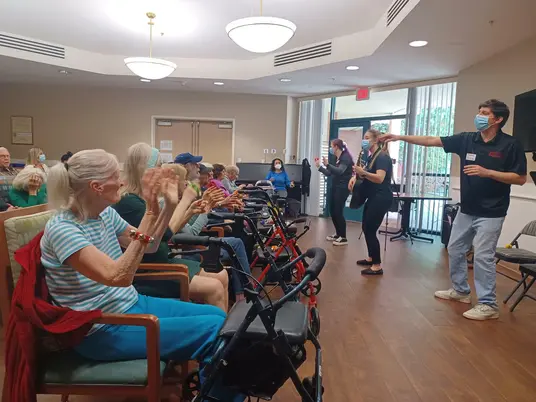
Conducted in partnership with the Music Therapy program at California State University, Northridge (CSUN), Los Angeles Jewish Health’s therapeutic music services bring CSUN students to the LAJH campus to stimulate and engage residents with population-appropriate activities. The students – juniors and seniors at CSUN – are working toward their Bachelor of Arts in Music Therapy; once they complete their degree, finish a six-month internship (including 1,200 hours of clinical training), and pass a board certification exam, they become board-certified music therapists. CSUN’s Music Therapy program – an important and growing major at the nexus of healthcare and music – is the only one in the California State University system.

“Music therapy helps promote functional changes in behavior,” says Hilary Yip, chair of Music Therapy at CSUN. “It’s based on science – understanding how our bodies and brains react and respond to music. Music therapists work with people from infancy through their senior years, boosting their social and emotional skills, cognitive and motor skills, and the ability to communicate. For instance, music can help reduce the suffering of adolescents with depression and anxiety and assist adults with dementia in accessing their memories.”

Los Angeles Jewish Health’s collaboration with CSUN is new, and Stacy Orbach, LAJH’s director of volunteer services, is already seeing results. “It’s a win-win situation because the students get experience in their field, and our residents benefit from afternoons filled with music and joy,” she says. “Music is so powerful: It can bring older adults back to a particular time and place in their lives. I’ve been amazed watching their reactions as they travel that path.”

Music has always played a central role at Los Angeles Jewish Health, and volunteers frequently visit to share their talents with residents. But the joint effort with CSUN pairs music enjoyment with a more scientific approach.

“One of the things that’s remarkable about the CSUN partnership is that it both benefits our seniors by making them feel good, and it is also data driven, producing findings that can contribute to the body of medical knowledge about aging and potentially improving seniors’ quality of life down the line,” says Dale Surowitz, chief executive officer and president of Los Angeles Jewish Health.
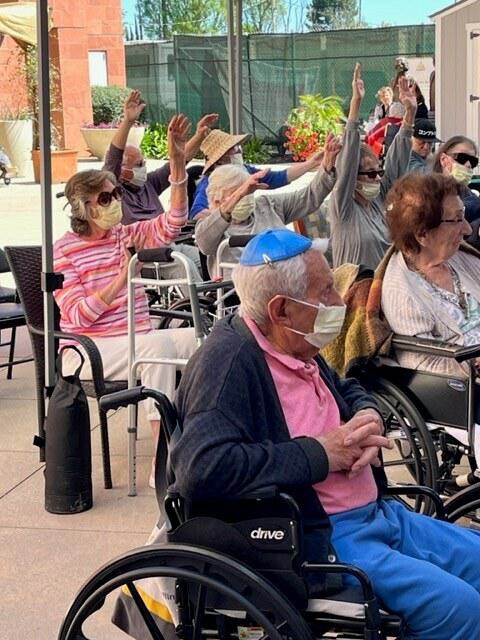
Music therapy 2

The program is equally beneficial for the students, enabling them to acquire hands-on experience of going into the community and working with clients. “In class, they’re just playing music for each other, but at Los Angeles Jewish Health, they can witness, first-hand, how their music brings a smile to seniors’ faces,” Hilary says. “It’s so rewarding for them to elicit that reaction and to see how they can use music to impact someone else.”

As part of the partnership, Stacy and LAJH Special Programs Coordinator Julie Lockman-Gold make presentations to CSUN Music Therapy students at the start of each semester, introducing them to Los Angeles Jewish Health and to the needs of its senior population. Over the course of the semester, the students build warm relationships with LAJH residents, forming bonds that enhance the seniors’ sense of fulfillment and well-being.

“Our residents couldn’t be more enthusiastic about these interactions,” Julie says. “At the end of every session, they encourage the students to come back any time.”

Early response to the program has made it a standout success. “I’m so delighted by the feedback we’ve received from our seniors,” Stacy says. “We’re in this partnership for the long term.”
Sign up for the Los Angeles Jewish Health newsletter, Connections.

Recent Articles

Feb 12

3rd Annual LAJH Classic & Exotic Car Show

Read More
Feb 11

Major Changes in the Tax Law This Year: What It Means for You, Your Taxes, and Your Legacy

Read More
Feb 4

Los Angeles Jewish Health Pays Tribute to Martin Luther King, Jr. and Reflects on His Powerful Legacy

A shared focus on the pursuit of justice made the late Dr. Martin Luther King, Jr. and his contemporaries in the American Jewish community natural allies. This past January, Los Angeles Jewish Health honored their historic collaboration with a special Martin Luther King, Jr. Day event that brought together a diverse audience to celebrate Dr. King and help carry his legacy forward.Overseen by Rabbi Karen Bender, LAJH’s chief mission officer, the gathering featured timeless music blending Jewish songs and themes with gospel sounds rooted in the African American tradition. The program was led by Hazan Mike Stein, who served as cantor of Temple Aliyah—now HaMakom—in West Hills for more than two decades and included contributions from Cantor Jenni Asher, HaMakom’s current cantor; Broadway actress Deborah Sharpe-Taylor; singer Fumani Thomas-Schwartz; pianist David Cohen; and numerous others.“Our goal was to present a fusion of music and ideas about the melding of the two cultures, Jewish and African American,” Stein says. “We sang a song I wrote with Deborah called ‘Shalom, Shalom’; ‘Wade in the Water,’ a traditional African American spiritual that was combined with ‘Mi Chamocha’; ‘We Shall Overcome’; and ‘When the Rain Comes Down,’ which speaks to the universal struggles we all go through, no matter our faith or background. Rabbi Bender also offered a beautiful d’var Torah.”The group performs music which blends songs and themes with gospel sounds rooted in the African American tradition. Rabbi Bender’s words of wisdom helped ground the emotionally uplifting musical tribute, emphasizing how the values of Dr. King align completely with Jewish values.“Our resident community at LAJH intuits the profundity of a message that relates to the principles of justice, equality, and loving-kindness,” she said.A highlight of the event was Sharpe-Taylor’s performance as Harriet Tubman. She offered a first-person portrayal of the iconoclastic activist and brought to life her role in the Underground Railroad.“The residents loved Deborah’s reenactment. She tried to embody Harriet, talking about her life, missing her husband, and bringing people to freedom,” Asher says. “When she was finished, Rabbi Bender got up and said, ‘I almost feel as if I met Harriet Tubman today!’”During the program, Asher, the first Black female cantor to be ordained in the United States, offered insights into her own experience as a Jew of color.“It’s amazing to be visible: I have people come up to me all the time to say they’ve never seen a Black or even a female cantor,” she says. “But Jews and Judaism have moved so far in terms of diversity, and I think it’s impactful for seniors to witness this evolution for themselves. The residents of Los Angeles Jewish Health were so warm and happy to see me, which was wonderful.”Also on hand for the event were William “Mickey” Stevenson and his wife, Michelle. Mickey, a legendary producer at Motown Records and one of the principal architects of the “Motown Sound,” talked about the outstanding partnership at the label between Black artists and its executives, some of whom were Jewish.Cantor Stein says the program was particularly resonant for many of the LAJH residents in the audience.“A lot of the seniors remember the ‘60s and were politically active, some of them playing important roles in advancing civil rights in their local communities,” he says. “In fact, my wife, Kelley, an LAJH resident, was actually at the “I Have a Dream” speech march! When Rabbi Bender talked about how Black and Jewish people are connected by traditions that encompass both being slaves and being free, you could see people nodding along. It’s a powerful link that gives us all common ground to stand up for what’s right.”Cantor Jenni Asher Deborah Sharpe-Taylor as Harriet TubmanWilliam “Mickey” Stevenson 
Read More