Eyes Can Smile

Connections to Care Mobile Hero
Home / News & Events / Newsletter

Eyes Can Smile

May 4, 2021

Until recently, I never fully appreciated how eyes can smile. I knew that eyes could see. I even knew that eyes could connect, as when two people really pay attention to one another. Over this past year, eyes over masks that conveyed sadness and longing had been heavy for our hearts to bear. We all know this—we have been in it together.

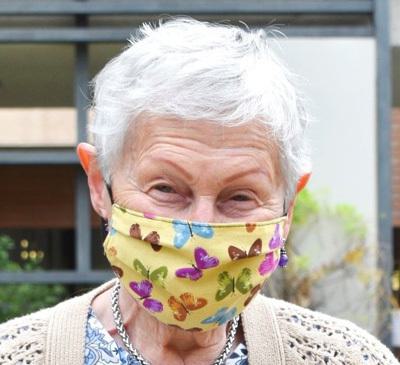
So you can imagine how exhilarating it has been, over these past few weeks, to witness smiling eyes. Family visitors smile with their eyes, staff smile with their eyes, and most importantly, our residents are smiling again, even if with their eyes. "Open my eyes that I may perceive the wonders of Your teaching," says the Psalmist (119:18).

Learning in person, not only in some schools, but also here at the Home has resumed. Recently, I was teaching a class about Jewish views on justice. A resident became so excited as she shared her opinions and ideas that she started to pull down her mask. For a split second, I saw that she was wearing lipstick! Even though she wears a mask and we cannot typically see her smiling mouth, she could see her own lips. I reassured her, "You can keep your mask on. I can hear you with my ears and by looking at your eyes."
Coming soon is the Jewish holiday of Shavuot, the holiday when we stand again at Mount Sinai, as it were, and joyfully accept the Torah and Ten Commandments as our ancestors did originally. In light of the upcoming holiday I want to share with you what I have seen and what I see now at our extraordinary Los Angeles Jewish Home.

Remember at Passover, we used our imaginations to "remember" we were slaves in Egypt? We remembered that bitterness of slavery and the sense of longing to leave those terrible conditions. COVID-19 was a sort of Egypt for our residents, as their normal activities and freedoms were unavailable for their own safety.

After Passover, we count the days to Shavuot. We continue in the realm of imagination. Sure, we were slaves, but now we are free. We have a purpose, to journey towards the promised land. And on that journey we stand together at Mount Sinai, connected with each other and with G-d, to receive the Torah.

The eyes of joy that I see today remind me of the exhilaration of Mount Sinai. It is as if a light that had been a bit dimmed has begun to burn brighter, like the rays of light radiating above the eyes of Moses as he comes down the mountain to present the gift.

Thank you to all of you who have given the gift of visits, support, and love of the Los Angeles Jewish Home. Those smiling eyes are in large part because of you.

Rabbi Karen Bender

Sign up for the Los Angeles Jewish Health newsletter, Connections.

Recent Articles

Feb 12

3rd Annual LAJH Classic & Exotic Car Show

Read More
Feb 11

Major Changes in the Tax Law This Year: What It Means for You, Your Taxes, and Your Legacy

Read More
Feb 4

Los Angeles Jewish Health Pays Tribute to Martin Luther King, Jr. and Reflects on His Powerful Legacy

A shared focus on the pursuit of justice made the late Dr. Martin Luther King, Jr. and his contemporaries in the American Jewish community natural allies. This past January, Los Angeles Jewish Health honored their historic collaboration with a special Martin Luther King, Jr. Day event that brought together a diverse audience to celebrate Dr. King and help carry his legacy forward.Overseen by Rabbi Karen Bender, LAJH’s chief mission officer, the gathering featured timeless music blending Jewish songs and themes with gospel sounds rooted in the African American tradition. The program was led by Hazan Mike Stein, who served as cantor of Temple Aliyah—now HaMakom—in West Hills for more than two decades and included contributions from Cantor Jenni Asher, HaMakom’s current cantor; Broadway actress Deborah Sharpe-Taylor; singer Fumani Thomas-Schwartz; pianist David Cohen; and numerous others.“Our goal was to present a fusion of music and ideas about the melding of the two cultures, Jewish and African American,” Stein says. “We sang a song I wrote with Deborah called ‘Shalom, Shalom’; ‘Wade in the Water,’ a traditional African American spiritual that was combined with ‘Mi Chamocha’; ‘We Shall Overcome’; and ‘When the Rain Comes Down,’ which speaks to the universal struggles we all go through, no matter our faith or background. Rabbi Bender also offered a beautiful d’var Torah.”The group performs music which blends songs and themes with gospel sounds rooted in the African American tradition. Rabbi Bender’s words of wisdom helped ground the emotionally uplifting musical tribute, emphasizing how the values of Dr. King align completely with Jewish values.“Our resident community at LAJH intuits the profundity of a message that relates to the principles of justice, equality, and loving-kindness,” she said.A highlight of the event was Sharpe-Taylor’s performance as Harriet Tubman. She offered a first-person portrayal of the iconoclastic activist and brought to life her role in the Underground Railroad.“The residents loved Deborah’s reenactment. She tried to embody Harriet, talking about her life, missing her husband, and bringing people to freedom,” Asher says. “When she was finished, Rabbi Bender got up and said, ‘I almost feel as if I met Harriet Tubman today!’”During the program, Asher, the first Black female cantor to be ordained in the United States, offered insights into her own experience as a Jew of color.“It’s amazing to be visible: I have people come up to me all the time to say they’ve never seen a Black or even a female cantor,” she says. “But Jews and Judaism have moved so far in terms of diversity, and I think it’s impactful for seniors to witness this evolution for themselves. The residents of Los Angeles Jewish Health were so warm and happy to see me, which was wonderful.”Also on hand for the event were William “Mickey” Stevenson and his wife, Michelle. Mickey, a legendary producer at Motown Records and one of the principal architects of the “Motown Sound,” talked about the outstanding partnership at the label between Black artists and its executives, some of whom were Jewish.Cantor Stein says the program was particularly resonant for many of the LAJH residents in the audience.“A lot of the seniors remember the ‘60s and were politically active, some of them playing important roles in advancing civil rights in their local communities,” he says. “In fact, my wife, Kelley, an LAJH resident, was actually at the “I Have a Dream” speech march! When Rabbi Bender talked about how Black and Jewish people are connected by traditions that encompass both being slaves and being free, you could see people nodding along. It’s a powerful link that gives us all common ground to stand up for what’s right.”Cantor Jenni Asher Deborah Sharpe-Taylor as Harriet TubmanWilliam “Mickey” Stevenson 
Read More