Celebrating the Wonder and the Miracle of Chanukah 

Connections to Care Mobile Hero
Home / News & Events / Newsletter

Celebrating the Wonder and the Miracle of Chanukah

Dec 7, 2022

To borrow from Adam Sandler, "Chanukah is the Festival of Lights. Instead of one day of presents, we have eight crazy nights". From those words of wisdom, we get the questions to address. What is this Festival of Lights? Why eight nights? In addition, while sufganiyot (jelly doughnuts) and latkes (potato pancakes) are awesomely delicious, why are they associated with Chanukah?

In the larger universe of Jewish holidays, Chanukah is known to be a minor observance. It certainly is not a holiday or observance on the level of Passover or Sukkot, let alone Rosh Hashanah. Even as we know Chanukah is a minor festival, Chanukah is beloved and its existence is widely known, if not understood. Here in America, Chanukah gets extra exposure because of the proximity to the Christmas holiday. Christmas is always December 25 but Chanukah follows the Jewish-Lunar calendar and can occur as early as Thanksgiving or fall in the later part of December. In that range of dates, Chanukah falls during what is commonly called the Holiday Season and becomes incorporated into it.

That takes us to a uniquely American ideal about the make-up of our nation. We inscribe on the coins of our currency E Pluribus Unum- or in the English "Out of many one". In America, we celebrate being united; additionally we treasure what makes each part of the American mosaic unique. As the majority of Americans observe one holiday, Americans of the Jewish faith observe Chanukah. At its core, Chanukah is the celebration of maintaining that uniqueness. In the days following the breakup of the empire of Alexander the Great, the dominant culture in the Mediterranean world was the Greek culture. It would have been easy and made their lives simpler for the Jews of those times to be swallowed by that Greek culture. Yet, they refused, they rebelled against assimilation and they elected to fight to maintain the faith and identity they inherited from their ancestors. At the conclusion of this struggle to remain unique in a larger culture, it was time to dedicate the great Temple in Jerusalem. Part of the dedication or Chanukah was lighting the menorah. On hand was only enough oil to last 1 day. It would take several days for more oil to be procured. Rabbinic legend is that the oil that should have lasted for 1 day actually lasted eight. For that reason, we light candles in ascending numbers each night, to remember this miracle of the oil lasting. In observing Chanukah, we celebrate our unique identity in a larger world. Jews chose to retain the faith of those who came before us and treasure that faith and uniqueness in a diverse world.
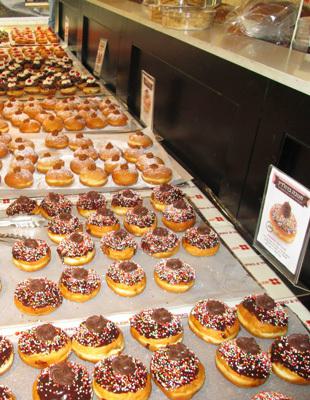
Finally and very importantly, why the latkes and sufganiyot? They are both linked to the miracle of the oil, as they both are fried foods. When I was a student in Israel, I marveled at the wide variety of sufganiyot-doughnuts on sale in every store and bakery. Naturally, I had to sample a cross section. My favorite? The chocolate frosted-halvah filled doughnut was the winner. Latkes are potato pancakes of course. There are many different recipes for them. You can use potatoes, sweet potatoes or even zucchini. Among the many toppings can be applesauce, sugar or what I recommend, sour cream. All are wonderful, all tasty without a doubt. Nevertheless, what is valued is to pause, gather together to bless and light the candles, sing the traditional songs and celebrate the wonder and miracle of Jewish identity in our day and time.

Sign up for the Los Angeles Jewish Health newsletter, Connections.

Recent Articles

Feb 12

3rd Annual LAJH Classic & Exotic Car Show

Read More
Feb 11

Major Changes in the Tax Law This Year: What It Means for You, Your Taxes, and Your Legacy

Read More
Feb 4

Los Angeles Jewish Health Pays Tribute to Martin Luther King, Jr. and Reflects on His Powerful Legacy

A shared focus on the pursuit of justice made the late Dr. Martin Luther King, Jr. and his contemporaries in the American Jewish community natural allies. This past January, Los Angeles Jewish Health honored their historic collaboration with a special Martin Luther King, Jr. Day event that brought together a diverse audience to celebrate Dr. King and help carry his legacy forward.Overseen by Rabbi Karen Bender, LAJH’s chief mission officer, the gathering featured timeless music blending Jewish songs and themes with gospel sounds rooted in the African American tradition. The program was led by Hazan Mike Stein, who served as cantor of Temple Aliyah—now HaMakom—in West Hills for more than two decades and included contributions from Cantor Jenni Asher, HaMakom’s current cantor; Broadway actress Deborah Sharpe-Taylor; singer Fumani Thomas-Schwartz; pianist David Cohen; and numerous others.“Our goal was to present a fusion of music and ideas about the melding of the two cultures, Jewish and African American,” Stein says. “We sang a song I wrote with Deborah called ‘Shalom, Shalom’; ‘Wade in the Water,’ a traditional African American spiritual that was combined with ‘Mi Chamocha’; ‘We Shall Overcome’; and ‘When the Rain Comes Down,’ which speaks to the universal struggles we all go through, no matter our faith or background. Rabbi Bender also offered a beautiful d’var Torah.”The group performs music which blends songs and themes with gospel sounds rooted in the African American tradition. Rabbi Bender’s words of wisdom helped ground the emotionally uplifting musical tribute, emphasizing how the values of Dr. King align completely with Jewish values.“Our resident community at LAJH intuits the profundity of a message that relates to the principles of justice, equality, and loving-kindness,” she said.A highlight of the event was Sharpe-Taylor’s performance as Harriet Tubman. She offered a first-person portrayal of the iconoclastic activist and brought to life her role in the Underground Railroad.“The residents loved Deborah’s reenactment. She tried to embody Harriet, talking about her life, missing her husband, and bringing people to freedom,” Asher says. “When she was finished, Rabbi Bender got up and said, ‘I almost feel as if I met Harriet Tubman today!’”During the program, Asher, the first Black female cantor to be ordained in the United States, offered insights into her own experience as a Jew of color.“It’s amazing to be visible: I have people come up to me all the time to say they’ve never seen a Black or even a female cantor,” she says. “But Jews and Judaism have moved so far in terms of diversity, and I think it’s impactful for seniors to witness this evolution for themselves. The residents of Los Angeles Jewish Health were so warm and happy to see me, which was wonderful.”Also on hand for the event were William “Mickey” Stevenson and his wife, Michelle. Mickey, a legendary producer at Motown Records and one of the principal architects of the “Motown Sound,” talked about the outstanding partnership at the label between Black artists and its executives, some of whom were Jewish.Cantor Stein says the program was particularly resonant for many of the LAJH residents in the audience.“A lot of the seniors remember the ‘60s and were politically active, some of them playing important roles in advancing civil rights in their local communities,” he says. “In fact, my wife, Kelley, an LAJH resident, was actually at the “I Have a Dream” speech march! When Rabbi Bender talked about how Black and Jewish people are connected by traditions that encompass both being slaves and being free, you could see people nodding along. It’s a powerful link that gives us all common ground to stand up for what’s right.”Cantor Jenni Asher Deborah Sharpe-Taylor as Harriet TubmanWilliam “Mickey” Stevenson 
Read More