When It Comes to Providing Expert Care for Veterans, Los Angeles Jewish Health Is Proud to Serve

Connections to Care Mobile Hero
Home / News & Events / Newsletter

When It Comes to Providing Expert Care for Veterans, Los Angeles Jewish Health Is Proud to Serve

Oct 31, 2023

In December 2022, when Navy veteran Ed Vibar, 72, first came to Los Angeles Jewish Health’s Brandman Centers for Senior Care (BCSC), a Program of All-inclusive Care for the Elderly (PACE), he rolled his wheelchair through the doors. Ed had been unable to walk for four years, following an ankle injury. He had begun to lose hope that he would ever recover his mobility and had turned to LA Jewish Health and BCSC PACE as a last resort.

For Ed, the road to Los Angeles Jewish Health had been a winding one. He immigrated to the United States from the Philippines as a young man and enlisted to serve his adopted country, spending 12 years on active duty and another five in the Naval Reserve. He loved his work, which included stints on a guided missile destroyer in Vietnam and a project management position that had him collaborating with the Army Corps of Engineers to oversee a $300 million budget. During the course of his career, Ed was married three times and had four children, bringing him the attendant joys and heartaches that can accompany domestic life.
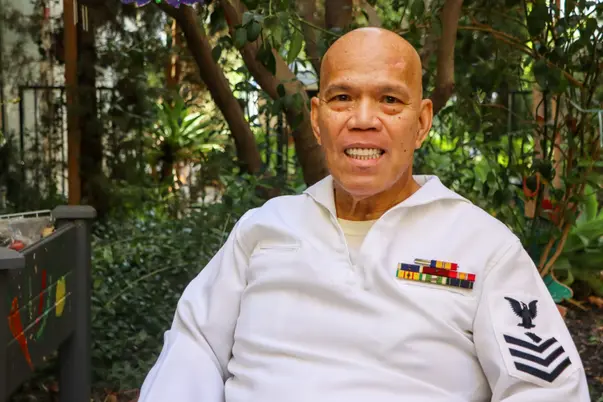
Ed Vibor Veteran Recovered at Brandman Centers for Senior Care
Ed Vibar

Retirement brought an end to Ed’s health insurance, so when he injured his ankle in his late 60s, he sought care at his local Veteran’s Affairs Hospital. Though imaging showed damage to nerve tissue and tendons, at that time Ed was told the VA lacked the resources to provide appropriate therapy, and doctors informed him he was unlikely to recover the ability to walk. Meanwhile, the longer he remained confined to a wheelchair, the more his health declined, and he began to suffer from gout, high blood pressure, and depression. Being unable to drive made it hard to buy groceries and cook nutritious meals, and eventually, he lost all his teeth.

When he saw a brochure for BCSC PACE, Ed decided to investigate. “I went online and realized BCSC PACE was exactly what I needed,” he recalls. “In addition to offering state-of-the-art physical therapy, they would also coordinate all of my care and provide transportation, which was becoming increasingly difficult for me to access. And the costs were all taken care of thanks to my Medicare and Medi-Cal coverage!”

At BCSC PACE, Ed was paired up with Jensen De La Luna, an expert physical therapist who went to work creating a rigorous treatment plan. “Ed was clearly depressed, and initially, his drive to get better was fairly low. But we dove into therapy twice each week, and his motivation picked up. After three months, he started walking again,” Jensen says.

For Ed, being able to get up and around with a walker was transformational. “Jensen inspired me to try, which really gave me a boost,” he says. “I kept thinking, if I work a little harder, I can travel to see my grandchildren.”

Soon, he was able to stand on his feet to cook, do dishes, and clean up after his dog. “It really changed my life, and I did end up taking the train to Texas, all on my own, to see my grandkids,” he says. “I owe it all to LA Jewish Health’s BCSC PACE program!”

Today, Jensen says Ed’s mobility has increased by more than 50 percent – and his pain has decreased by an equal amount. “I’m so happy for him,” Jensen says. “It’s amazing to see that someone who used to require a wheelchair to come see me can now walk right through the door!”

In addition to physical therapy, Ed also received occupational therapy (to help improve his performance of daily tasks) at the BCSC PACE program – and he had a team of professionals helping meet his other medical issues, as well. “I didn’t have proper teeth, and BCSC PACE got full dentures for me right away. Now, I can eat everything, including a full steak dinner. They were so amazing at anticipating my needs,” he says. “I used to be afraid to smile, but now I want to open my mouth wide and say, ‘Come to the BCSC PACE program and Los Angeles Jewish Health!’ I would recommend it to any veterans, and to all seniors who want to get better healthcare and improve their life situation.”

The Brandman Centers for Senior Care’s PACE program continues to expand to meet the needs of the community. The newest site – on Pico Boulevard, in West Los Angeles – is scheduled to open this November. For more information call (818) 774-8444 or go to BrandmanSeniorCare.org.
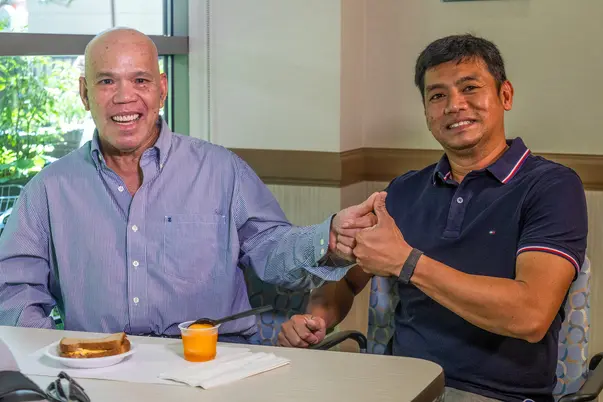
Ed Vibor and Physical Therapist Jensen Dela Luna
Ed Vibar and Physical Therapist Jensen De La Luna


Sign up for the Los Angeles Jewish Health newsletter, Connections.

Recent Articles

Feb 4

Los Angeles Jewish Health Pays Tribute to Martin Luther King, Jr. and Reflects on His Powerful Legacy

A shared focus on the pursuit of justice made the late Dr. Martin Luther King, Jr. and his contemporaries in the American Jewish community natural allies. This past January, Los Angeles Jewish Health honored their historic collaboration with a special Martin Luther King, Jr. Day event that brought together a diverse audience to celebrate Dr. King and help carry his legacy forward.Overseen by Rabbi Karen Bender, LAJH’s chief mission officer, the gathering featured timeless music blending Jewish songs and themes with gospel sounds rooted in the African American tradition. The program was led by Hazan Mike Stein, who served as cantor of Temple Aliyah—now HaMakom—in West Hills for more than two decades and included contributions from Cantor Jenni Asher, HaMakom’s current cantor; Broadway actress Deborah Sharpe-Taylor; singer Fumani Thomas-Schwartz; pianist David Cohen; and numerous others.“Our goal was to present a fusion of music and ideas about the melding of the two cultures, Jewish and African American,” Stein says. “We sang a song I wrote with Deborah called ‘Shalom, Shalom’; ‘Wade in the Water,’ a traditional African American spiritual that was combined with ‘Mi Chamocha’; ‘We Shall Overcome’; and ‘When the Rain Comes Down,’ which speaks to the universal struggles we all go through, no matter our faith or background. Rabbi Bender also offered a beautiful d’var Torah.”The group performs music which blends songs and themes with gospel sounds rooted in the African American tradition. Rabbi Bender’s words of wisdom helped ground the emotionally uplifting musical tribute, emphasizing how the values of Dr. King align completely with Jewish values.“Our resident community at LAJH intuits the profundity of a message that relates to the principles of justice, equality, and loving-kindness,” she said.A highlight of the event was Sharpe-Taylor’s performance as Harriet Tubman. She offered a first-person portrayal of the iconoclastic activist and brought to life her role in the Underground Railroad.“The residents loved Deborah’s reenactment. She tried to embody Harriet, talking about her life, missing her husband, and bringing people to freedom,” Asher says. “When she was finished, Rabbi Bender got up and said, ‘I almost feel as if I met Harriet Tubman today!’”During the program, Asher, the first Black female cantor to be ordained in the United States, offered insights into her own experience as a Jew of color.“It’s amazing to be visible: I have people come up to me all the time to say they’ve never seen a Black or even a female cantor,” she says. “But Jews and Judaism have moved so far in terms of diversity, and I think it’s impactful for seniors to witness this evolution for themselves. The residents of Los Angeles Jewish Health were so warm and happy to see me, which was wonderful.”Also on hand for the event were William “Mickey” Stevenson and his wife, Michelle. Mickey, a legendary producer at Motown Records and one of the principal architects of the “Motown Sound,” talked about the outstanding partnership at the label between Black artists and its executives, some of whom were Jewish.Cantor Stein says the program was particularly resonant for many of the LAJH residents in the audience.“A lot of the seniors remember the ‘60s and were politically active, some of them playing important roles in advancing civil rights in their local communities,” he says. “In fact, my wife, Kelley, an LAJH resident, was actually at the “I Have a Dream” speech march! When Rabbi Bender talked about how Black and Jewish people are connected by traditions that encompass both being slaves and being free, you could see people nodding along. It’s a powerful link that gives us all common ground to stand up for what’s right.”Cantor Jenni Asher Deborah Sharpe-Taylor as Harriet TubmanWilliam “Mickey” Stevenson 
Read More
Feb 4

Embracing Life at Los Angeles Jewish Health Without Missing a Beat

Los Angeles Jewish Health rehabilitation patient Thomas Flynn has led a life full of success and accomplishment. But his most recent achievement may well be his greatest yet: surviving and thriving nearly one year after a high-stakes heart transplant.Tom’s health had been on a steady downward trajectory as doctors tried everything possible to address his ventricular tachycardia, a heart rhythm disorder that disrupted the electrical signals necessary for smooth cardiac functioning. After years of treatment and despite utilizing the latest in state-of-the-art medical advances (including surgical ablations and the placement of an implantable cardioverter defibrillator), doctors told him he had reached the end of the road.“I was basically out of options except for a transplant, and at 73 I was older than usual for that kind of procedure,” Tom says. “But I knew I wouldn’t be able to survive long term without it—I had been in the hospital 266 out of 365 days that year, which gives you an indication of how dire my circumstances were.”But Tom was otherwise healthy, without any comorbidities, and his doctors at Cedars-Sinai put him on the transplant list. Their decision saved his life.“It was a long shot, but they took a chance on me. I was the oldest person at Cedars-Sinai to get a transplant last year, and through what feels like a series of miracles, here I am today having turned 74,” Tom says.Those miracles include his medical team at Cedars-Sinai, a donor heart that matched his profile (“I think of that person every single day”), and the rehabilitation care he is receiving at LAJH.“I’ve been in JEK [the Joyce Eisenberg-Keefer Medical Center] for the past six months, and when I first got here, I was hooked up to so many machines that I couldn’t even leave my room for three months,” Tom recalls. “But the team at LAJH is amazing, from the doctors to the senior nursing staff, all the way to the certified nursing assistants. Now, I’m up and walking around, doing things I never thought I’d have the chance to do again!”Thomas FlynnBesides receiving rigorous occupational and physical therapy, Tom is an active member of the resident community.“The therapeutic activities here are incredible. The staff does so much to make sure our neural networks are firing and cognitive synapses are working—hosting discussion groups and learning activities that have residents reaching deep. It’s so gratifying,” he says.The intellectual stimulation has been critically important to Tom, who spent his career in both government and industry working on big ideas to strengthen the fabric of American society.After graduating from Columbia University and Santa Clara University School of Law, he joined the administration of Governor Jerry Brown in Sacramento, where he worked to open California up to international investment and supported the development of Silicon Valley. From there, he pivoted to the private sector, helping bring the first generation of electricity-generating windmills to Palm Springs and facilitating the acquisition of agricultural technology from Israel. Tom’s multifaceted career also included stints as chief executive officer of one of the nation’s premier public opinion and social research firms—where he managed Times/CNN polling for the 1992 and 1996 presidential election cycles—and time as a government consultant collaborating on impactful studies for the Department of Defense and other agencies.He and his wife, Cari Beauchamp, a prominent writer and journalist, split their time between Los Angeles, Washington, D.C., and New York, making their marks professionally while also raising their two sons, Jake and Teo. Cari passed away from cancer in 2023.At LAJH, in addition to recovering his physical stamina and sharpening his mental acuity, Tom has fostered new friendships with other JEK residents.“People are so smart and have such fascinating life stories. All of us are here because of medical infirmities, but we still have so much to offer in terms of our various skills and talents,” he says. “The entire LAJH community keeps me active and stimulated, and I’m so grateful every single day.” 
Read More
Jan 7

Illuminating Celebration and Pride: Chanukah at Los Angeles Jewish Health

Each year, Chanukah invites us to look back at the courage of the Maccabees, a small band that fought not only for survival, but for the right to live openly and proudly as Jews. Their story reminds us that Jewish pride is not loud or boastful; it is steady, resilient, and deeply rooted in identity and purpose. In every generation, Chanukah lifts that message like a flame, and this year at Los Angeles Jewish Health, that flame of pride glowed especially bright.So many of our residents grew up in times and places where Jewish identity was something to be quiet about or carefully held inside. Not only in countries in a state of danger or upheaval, but even in American cities, in neighborhoods, clubs, parks, and workplaces, where subtle messages made it clear that being Jewish was something to soften or conceal. And yet, they persevered. They built families, communities, and lives of meaning, carrying their Judaism forward with quiet strength.Here, at LAJH, no one needs to tuck that part of themselves away. Being Jewish is safe. Indeed, here pride is not resisted; it is cherished. Our residents gather to celebrate, sing, study, light candles, and tell stories not only of the past, but of the journeys that brought them to this community. They are surrounded by peers, caregivers, and friends who honor their heritage and uplift who they are. The joy of Chanukah becomes not only a memory of courage but a living experience of belonging. The plethora of celebratory foods, entertainment, and spiritual celebration serves to enhance it all.And beyond our own story, Chanukah offers an ethical calling: just as we affirm the dignity of Jewish identity, we affirm the dignity of every person. The Chanukah lights teach that every individual should have the right to be themselves. Every human being should enjoy the freedom to live authentically, to feel proud of who they are, and to shine in the fullness of their own unique light. Images of Chanukah from across Los Angeles Jewish Health:
Read More